McAllen Septic: Hidalgo County Septic Requirements for McAllen Homes
McAllen Septic wrote this guide for homeowners around McAllen who are not deciding whether to buy septic work, only who from, because a rule has already decided the rest. A new house needs a permitted system, an aerobic system needs a maintenance contract, and a repair to a tank or drain field needs a permit for the whole system. This guide sets out the state rule, 30 TAC Chapter 285, and the stricter rules Hidalgo County adds on top.
Who Issues a Septic Permit Around McAllen
TCEQ writes the state rule and lets local authorities run the permits. In unincorporated Hidalgo County that authority is Hidalgo County Health & Human Services, Environmental Health Division, 2818 S Business Hwy 281, Suite 7, in Edinburg. To schedule an OSSF inspection, call (956) 383-0111 or (956) 383-0112. The county's own OSSF web page has been taken down and its hours are not published, so call before you go.
Some cities run their own program. TCEQ lists the City of McAllen and the City of Mission as their own authorized agents, along with San Juan and Donna. Pharr regulates septic inside its limits under its own code, and Edinburg's Code Enforcement Office acts as the city's designated representative. McAllen's development code does not allow septic inside city limits at all; in its extraterritorial jurisdiction a permit needs both the county health official and McAllen Public Utilities. Inside Mission, ask Mission first (more on septic service in Mission).
Hidalgo County's Two Permits, Floodplain Check and Tract Rule
The county order (its 2010 text) is stricter than the state rule in several places. A permit is required on any tract size. A floodplain determination from the county Floodplain Administrator comes before the permit. The work takes two permits, one for Installation and one for Final Inspection.
- One single-family dwelling per system.
- Nothing in a spray area: no picnic tables, play equipment or BBQ pits.
- Installers keep their licence on the job site.
- No final light or water clearance until the house is connected to an approved system.
Half-Acre Lots, Lot Width and Engineer Designs
Under the state rule, a lot in a subdivision on public water using its own septic system must be at least half an acre; without public water, one acre. Hidalgo County's 2025 Subdivision Rules carry that into the plat: a septic lot must carry a plat note of at least 21,780 square feet, half an acre, with potable water. The minimum lot width is 50 feet on lots of half an acre or less and 65 feet on larger lots.
A lot under half an acre with no sanitary sewer needs an OSSF design plan by a licensed engineer, under the county Planning Department's procedure (Planning is at the same 2818 S Business Hwy 281 address, (956) 318-2840). Septic tanks are restricted in all floodplain hazard areas, and plats there need a special flood-zone design with tank anchoring, backflow valves and a sealed tank cover.
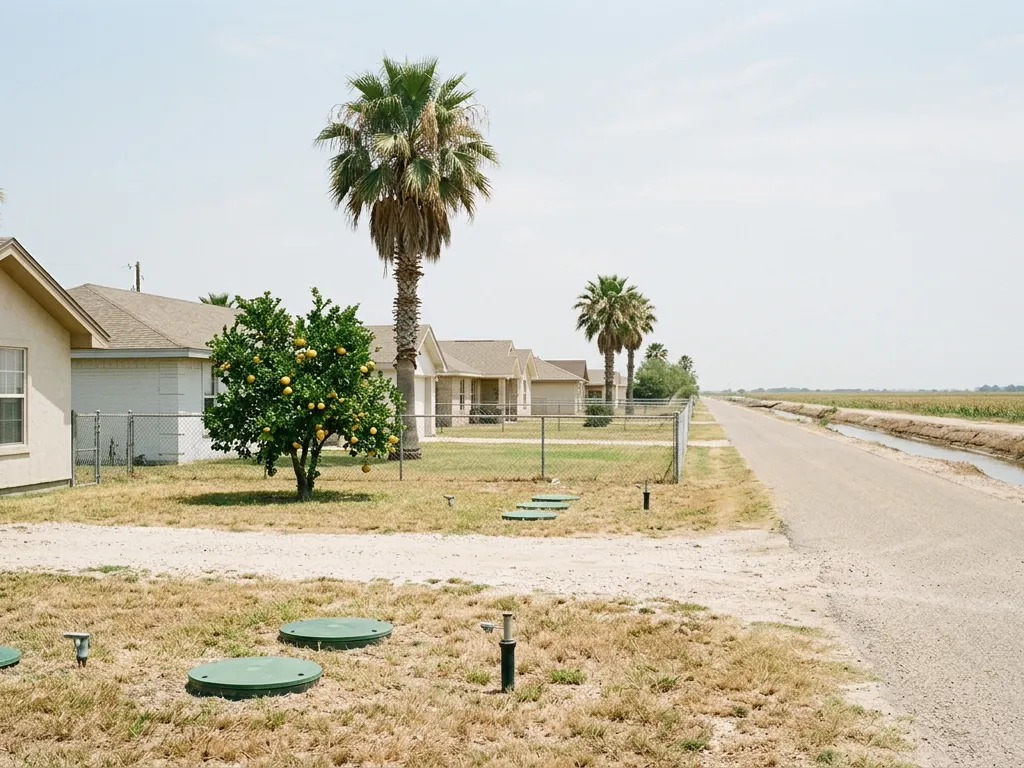
The Septic Site Evaluation Rule
Every new system starts with a site evaluation by a TCEQ-licensed site evaluator or a professional engineer. The rule (285.30) calls for two soil borings or two backhoe pits at opposite ends of the disposal area, dug two feet below the planned excavation or down to a restrictive layer, with a check for groundwater. Texas uses this soil evaluation, not a bare perc test. A septic site evaluation is billed apart from the county permit.
After that the clock is set by rule: the permitting authority decides an application within 30 days, an authorization to construct is valid one year, the installer gives five working days' notice for the construction inspection, and approval notice comes within seven calendar days of passing. State setbacks then fix where the tank and drain field can go, such as 50 feet from a private well for a tank and 100 feet for a drain field.
Who May Install, Repair and Pump in Texas
Anyone paid to build any part of a system must be a licensed installer. An Installer I may install standard systems, such as septic tanks, absorptive drain fields, leaching chambers and gravel-less pipe; an Installer II may install all types. A homeowner may install or repair a system on their own single-family property, but the site evaluation must still be done by a licensed site evaluator or an engineer.
Replacing a tank or a drain field is a repair that needs a permit for the whole system. Routine maintenance, including replacing pumps, filters, aerator lines, valves or electrical parts, does not. An emergency fix of a dangerous hazard, such as a broken lid or riser, needs only a written notice to the permitting authority, sent no later than 72 hours after the fix. Pumping is its own trade: only a transporter registered with TCEQ may pump and haul septage, and every pickup gets a trip ticket with a copy for the homeowner.
Aerobic Septic Rules: The Contract and the Four-Month Report
A new aerobic or other secondary-treatment system comes with a two-year maintenance contract with a licensed maintenance provider (285.7). After that, the state rule lets a single-family owner renew the contract or maintain the system personally; confirm with the county before you rely on that in Hidalgo County.
Under contract, the system is inspected, tested and reported on at least every four months, three times a year, and each report is filed with the permitting authority within 14 days. The contract names who maintains the chlorinator. TCEQ says to use calcium hypochlorite tablets made for wastewater disinfection, never swimming pool tablets, and the authority may inspect an aerobic system at any time. That four-month schedule is what an aerobic septic maintenance visit is built around.
Facing a permit, a repair or an aerobic contract near McAllen? Call to reach a local septic contractor.
Call (956) 758-8136Selling a House on Septic in Hidalgo County
Texas has no statewide point-of-sale septic inspection. A mortgage company may require one, but TCEQ says that "this type of evaluation is not required or regulated by TCEQ." The permit transfers to the buyer with the sale, and TCEQ tells buyers to notify the local permitting authority.
The seller answers septic questions on the TREC Seller's Disclosure Notice and attaches the Texas REALTORS form TXR 1407, "Information About On-Site Sewer Facility," which asks for the drain field location, the installer, the approximate age, any maintenance contract, when the tank was last pumped and any known defects.
Most of these rules land on the homeowner at one of three moments: building, repairing or selling. At each one, ask the permitting authority first, then get a written price for the work the rule requires.
Want a number for your own system? (956) 758-8136