McAllen Septic: How Often to Pump a Septic Tank in McAllen
How often to pump is the septic question with the most published answers, and this McAllen Septic guide sorts them out. TCEQ, EPA and Texas A&M AgriLife each give an interval, and they do not all agree. This guide lays them out, explains why a household in McAllen might land at the short end, and shows how a measured tank and a kept trip ticket take the guessing out of it.
The TCEQ Pumping Rule: Three to Five Years
For a conventional tank, TCEQ's guidance to owners is to pump every three to five years. That range is a starting point, not a promise, because the agency's own pumping table shows how fast it shrinks with use. A four-person home on a 1,000 gallon tank comes out at about 2.6 years, already under the bottom of the headline range.
The lesson from the table is that tank size and the number of people in the house drive the interval more than the calendar does. A couple on a 1,500 gallon tank and a family of five on a 1,000 gallon tank are running very different clocks. If you do not know your tank's size, the contractor who pumps it can tell you, and the trip ticket from that visit becomes the record.
EPA's Sludge and Scum Thresholds for Pumping
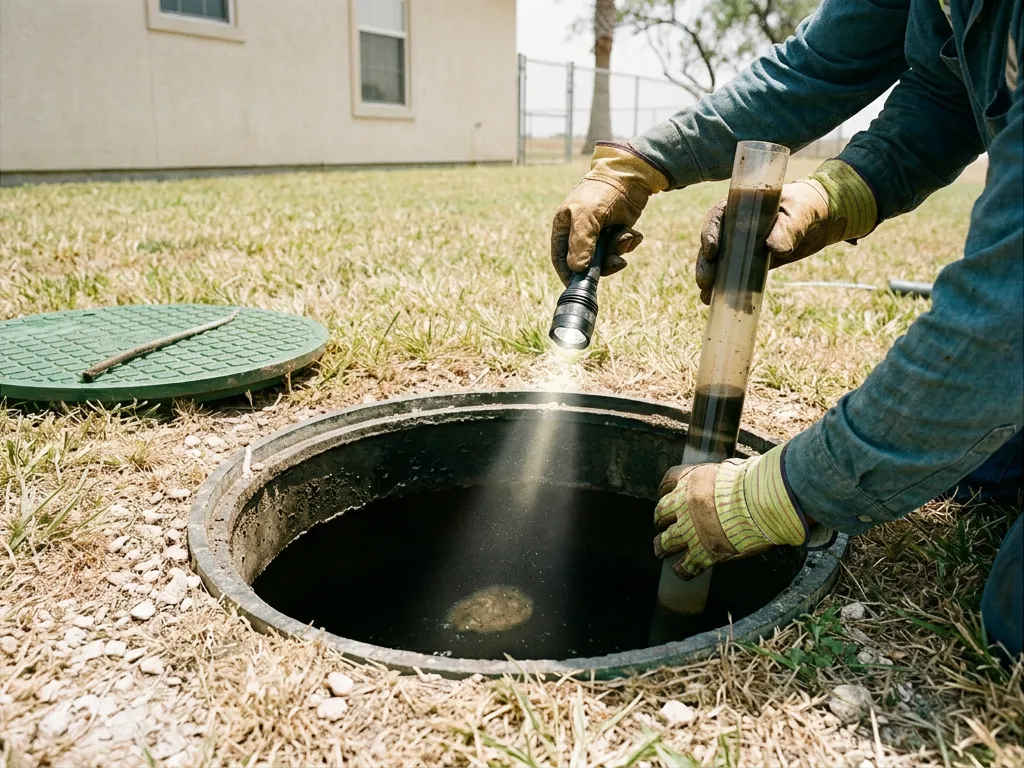
EPA's SepticSmart guidance agrees on three to five years for pumping and adds an inspection at least every three years. More useful than either number are its three triggers, which turn the decision into a measurement. Pump when any one of these is true:
- The scum layer is within six inches of the bottom of the outlet.
- The sludge layer is within 12 inches of the outlet.
- Sludge and scum together take up more than 25 percent of the liquid depth.
Why AgriLife's Older Septic Advice Says Two to Three Years
Older guidance repeats a shorter rule. Texas A&M AgriLife's 2008 sheet on septic operation and maintenance, L-5347, says every two to three years. It is not wrong so much as cautious, and for a busy household it lands close to TCEQ's 2.6 year figure anyway.
The practical way to settle the disagreement is to stop choosing between published numbers and look in the tank. An inspection that measures the sludge and scum against EPA's thresholds tells you whether this year is the year. A home that checks at three years and finds the layers thin can wait; one that finds them near the outlet should pump now.
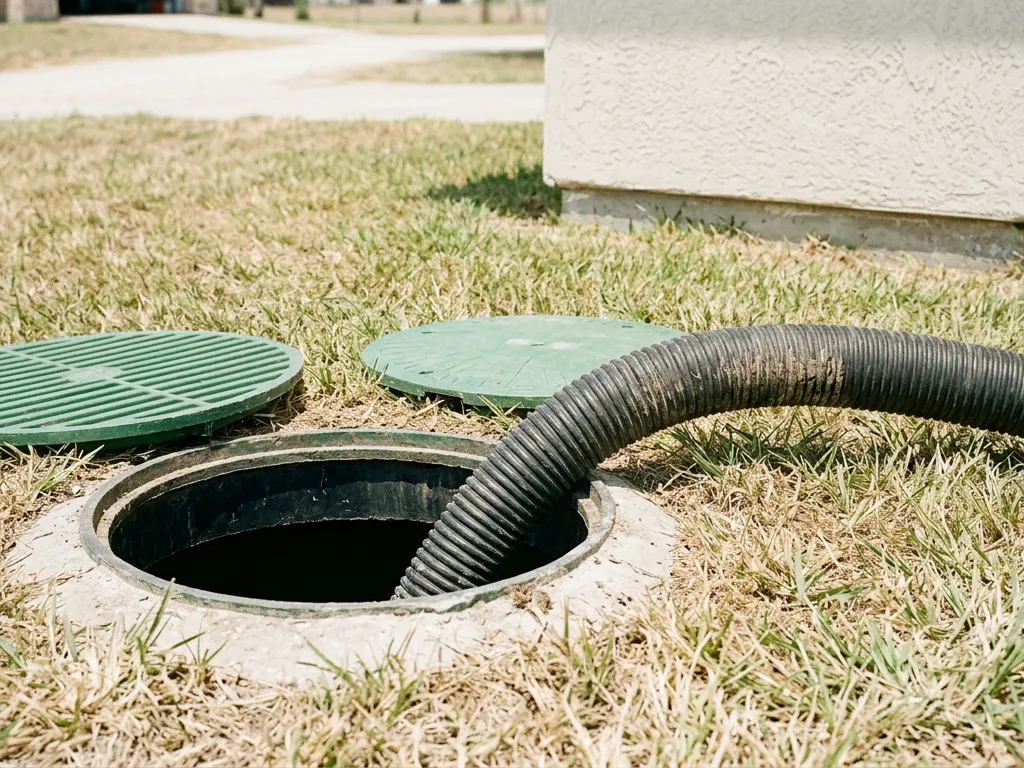
Septic Pumping Intervals at a Glance
Every interval below comes from the agency or publication named, so you can see where each figure starts.
| Source | What it says | Applies to |
|---|---|---|
| TCEQ | Pump every three to five years | Conventional tanks |
| TCEQ pumping table | About 2.6 years for four people on 1,000 gallons | Conventional tanks |
| EPA SepticSmart | Inspect at least every three years; pump every three to five | Household septic systems |
| EPA SepticSmart | Inspect about once a year | Systems with float switches, pumps or mechanical parts |
| AgriLife L-5347 (2008) | Pump every two to three years | Household septic systems |
| 30 TAC 285.7 | Inspect, test and report at least every four months | Aerobic and other secondary treatment |
Garbage Disposals, Big Households and a Shorter Pumping Cycle
EPA names the garbage disposal as one thing that shortens the time between pumpings, because ground food adds solids that settle in the tank. A house that runs one daily should plan for the short end of any range. Household size works the same way, as TCEQ's table shows, so a home that has added people since the last pumping has also moved its date forward.
Systems with mechanical parts add a second schedule. EPA suggests inspecting anything with float switches, pumps or other moving parts about once a year, separate from the pumping cycle. That covers pump tanks behind conventional drain fields as well as aerobic units.
Aerobic Septic Systems Run on a Four-Month Clock
An aerobic system is not left to the owner's memory. Under 30 TAC 285.7 it is inspected, tested and reported on at least every four months, three times a year, and the report goes to the permitting authority no later than 14 days after the visit. A new system starts with a two-year contract with a licensed maintenance provider; after that, the state rule lets a single-family owner renew the contract or do the maintenance personally, and the county is the place to confirm that before relying on it in Hidalgo County.
Those visits are the natural moment to ask the maintenance provider whether the tanks are due for pumping. A typical yearly plan with three inspections runs $275 to $535 (Texas Star Aerobic).
Keep the Septic Trip Ticket and What Pumping Costs
In Texas only a transporter registered with TCEQ may pump and haul septage, and each pickup gets a trip ticket with a copy for the homeowner. Keep it with the house papers. It is the simplest proof of when the tank was last pumped, and if you sell, the Texas REALTORS form TXR 1407 asks exactly that.
Fixr puts a typical cleaning at $300 to $600: $225 to $400 for a 1,000 gallon tank and $345 to $600 for 1,500 gallons. This Old House adds $100 to $300 for heavy sludge and $50 to $200 for a buried lid or poor access, which is what waiting too long and losing the lids both cost. A $300 to $600 pumping on schedule is the small bill; a $2,000 to $20,000 drain field replacement is the one it helps you avoid.
Due, overdue or not sure? Call and we will connect you with a local septic contractor who can measure the tank and give you a written price.
Call (956) 758-8136If you cannot find a trip ticket and nobody remembers the last pumping, treat the tank as due. A measured pump-out resets the clock and gives you a date to count from. Our septic tank cleaning page covers what the visit includes and what moves the price.
The same arithmetic holds for homes around Pharr and the rest of Hidalgo County: count the people, know the tank size, keep the ticket, and measure before you guess.
Want a number for your own system? (956) 758-8136